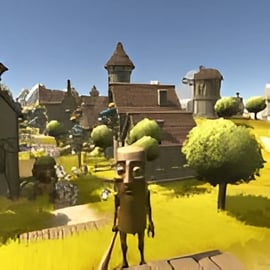
Grow Home is a charming physics based platformer that drops you into a vibrant sky full of floating islands, weird wildlife, and one gigantic plant that reaches into space. You play as B.U.D., a small red robot on a mission to grow and climb a massive Star Plant to save his home world. Instead of traditional scripted animations, the game uses procedural animation gameplay, so every step, grab, and stumble feels dynamic and slightly unpredictable.
This is an open world climbing game at heart. The world is almost entirely vertical, turning the sky itself into your playground. You aren’t stuck following strict paths; you decide which branch to grow, which floating rock to glide toward, and which secret caves to explore. The result is a relaxed but thrilling robot exploration adventure, where every new ledge you pull yourself onto offers a fresh view and new routes upward.
With its low-poly visual style, gentle atmosphere, and focus on experimentation, Grow Home is a standout vertical exploration platformer. It’s approachable for beginners but still satisfying for players who love mastering tricky physics-based climbing systems.
The controls in Grow Home are simple on paper but feel uniquely tactile in practice. Because your hands are controlled independently, climbing feels like you’re physically placing each grab. Exact key mappings can vary between platforms and any browser or cloud version you’re playing, but the underlying control ideas stay the same.
This dual-hand setup is the core of the physics based platformer design. Each grab latches onto the exact point you target, so your body reacts naturally to angles, slopes, and momentum.
Because Grow Home uses procedural animation gameplay, the same button presses can look different each time. B.U.D. might wobble, swing, or slip a little depending on how you approach a surface, which keeps the controls feeling playful and alive.
Grow Home mixes exploration, climbing, and physics into a compact but memorable adventure. These key features define the experience:
All of these systems combine into a vertical exploration platformer that’s easy to pick up but fun to master, whether you’re casually climbing or trying to reach every last secret island.
Because Grow Home is built as a physics based platformer with lots of moving parts, stable performance helps keep climbing responsive and safe. Specific technical options will depend on whether you’re playing a native PC/console version or a streamed or browser-based edition, but the general advice below applies broadly.
If you’re playing in a browser or cloud environment, also check for an updated browser version, disable unnecessary extensions, and make sure hardware acceleration is enabled when recommended by the platform.
Offline availability depends on how you access Grow Home:
Grow Home is mainly a solo robot exploration adventure. There’s no competitive online multiplayer in the base design, so once your copy is authorized by your chosen platform, gameplay itself doesn’t rely on other players or live services. For the most accurate answer, check the specific site or launcher you’re using and see whether it supports offline mode or requires a constant connection.
In all cases, your save data is tied to your local system or account, so you can pause, quit, and resume your vertical exploration platformer journey from your last checkpoint as long as your platform supports it.
The Star Plant is the star of this open world climbing game. It’s a gigantic, twisting vine that you must grow upward until it reaches your spaceship in orbit. Instead of being a static background object, it’s something you actively shape as you play.
Because you have control over which direction each branch grows, the vertical world becomes a puzzle. You can create shortcuts to certain floating islands, shape gentle ramps, or build wild spirals that loop around the sky. This flexibility is what turns Grow Home into a true vertical exploration platformer instead of a linear climb.
As you climb, you move through several distinct layers:
This layered structure keeps the robot exploration adventure feeling fresh. Each zone encourages different movement strategies, from careful hand-over-hand climbing to bold glides and leaps between branches.
B.U.D. (Botanical Utility Droid) is the clumsy but lovable hero of Grow Home. His entire design centers on curiosity and physical comedy, which fits perfectly with this physics based platformer style.
B.U.D. doesn’t speak in full sentences, but his personality comes through in how he moves. Thanks to procedural animation gameplay, he wobbles, teeters on edges, and flails when he catches himself from a long fall. This makes small successes — like sticking a landing on a tiny ledge — feel surprisingly satisfying.
You’re not entirely alone in this robot exploration adventure. B.U.D. is guided remotely by M.O.M., the ship’s main AI. Through short messages and mission updates, she nudges you along, celebrates big milestones, and adds a light narrative framing around your efforts to grow the Star Plant and save your home planet.
Together, they turn what could have been a purely mechanical climbing simulator into something more personal and charming.
Grow Home’s climbing feels different from most platformers because every grab is manual. There’s no automated “stick to wall” behavior. Instead, this vertical exploration platformer relies on you reading surfaces, timing grabs, and using momentum intelligently.
Because this is a physics based platformer, jumps and landings carry real weight:
Once you’re comfortable, the mix of climbing, jumping, and gliding makes the world feel like an enormous interactive playground.
Exploring every corner of this open world climbing game isn’t just for bragging rights. The world is packed with collectibles that directly improve how B.U.D. moves and survives.
The most important collectibles are glowing crystals scattered across cliffsides, caves, and floating islands.
Beyond crystals, Grow Home includes hidden nooks and oddities that enrich the robot exploration adventure:
Because the game is a vertical exploration platformer, many of these are on the underside of islands or tucked along narrow ledges. Rotating the camera low and looking up or down can reveal paths you’d easily miss from above.
Falling is a constant risk in Grow Home, but smart play can turn even big drops into safe (or at least recoverable) moments. These tips help you explore confidently while respecting the game’s physics.
Grow Home rewards curiosity, not rushing. Take time to:
By combining careful route planning with a willingness to experiment, you’ll get the most out of this physics based platformer’s sprawling vertical playground. Whether you’re climbing slowly hand-over-hand or gliding boldly between distant rocks, Grow Home turns every step upward into a tiny adventure.
A: Grow Home is a physics-based adventure platformer where you control a small robot named B.U.D. and climb a massive Star Plant to save his home planet.
A: Yes. Grow Home has a colorful, non-violent world and simple controls, making it friendly for kids and fun for families to play or watch together.
A: Not really. While timing helps, the focus is on exploration, careful climbing, and experimenting with physics rather than intense action or combat.
A: No. There is no traditional combat. The main challenge comes from navigating the environment, managing your climbs, and avoiding falls.
A: A focused playthrough can be completed in a few hours, but collecting crystals and exploring every floating island can extend your playtime.